VERAGMIL
Learning robotic granular food manipulation from virtual reality demonstrations
An imitation-learning framework for robot-assisted feeding
2025 IEEE/RSJ International Conference on Intelligent Robots and Systems
Overview
VERAGMIL is a simulation and data-collection framework for teaching robots to scoop and transport granular foods. It combines GPU-accelerated physics with a virtual reality interface so a person can demonstrate the task directly in 3D. The resulting data supports imitation learning for robot-assisted feeding scenarios where spillage and variation in food properties matter.
The study compares policies trained from VR and 3D space-mouse demonstrations using Behavioral Cloning (BC), recurrent Behavioral Cloning (BC-RNN), and Batch-Constrained Q-learning (BCQ). Performance is evaluated through task success, spillage, completion time, and generalization to unseen food items.
How it works
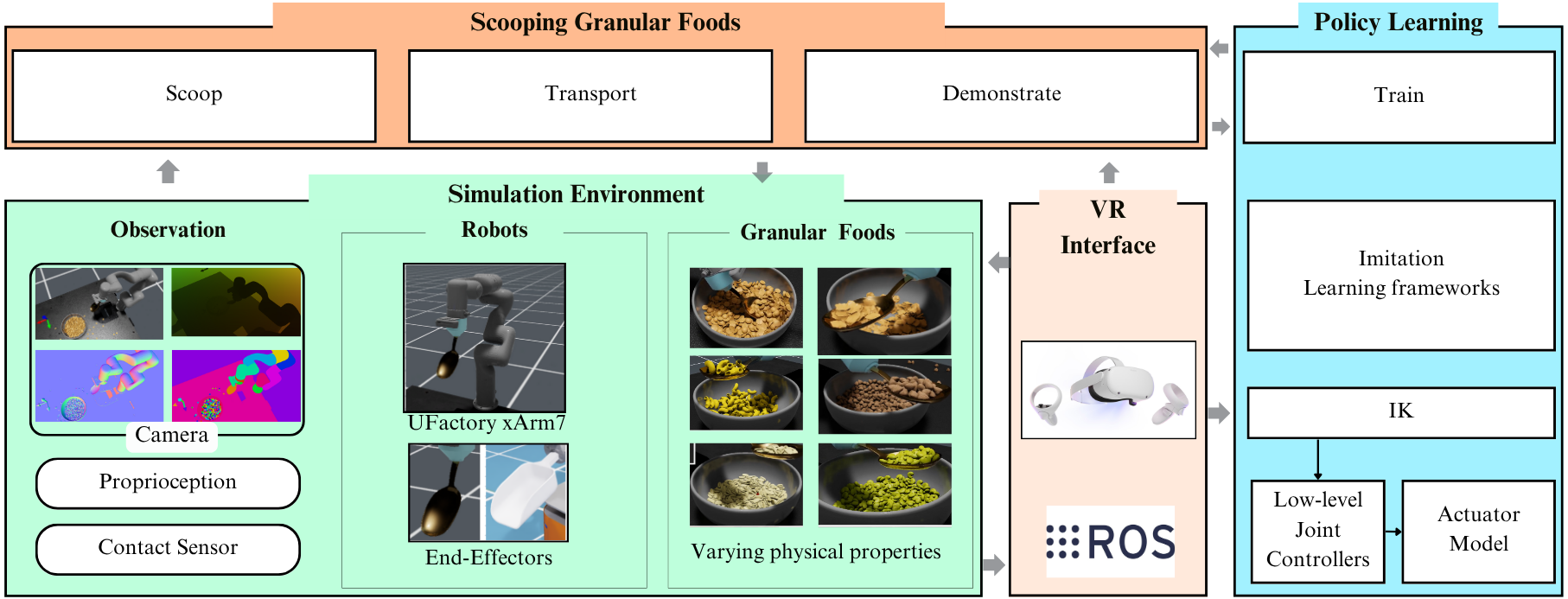
- Simulate. Granular foods with varied shapes and physical properties are modeled in NVIDIA Isaac Sim and Isaac Lab.
- Demonstrate. An operator records precise scooping and transport trajectories through VR; a 3D space mouse provides a comparison condition.
- Learn and evaluate. Imitation-learning policies are tested against a human-expert baseline and on food items not seen during training.
Evaluation design
The experiments separate two questions: how well different imitation-learning models perform, and how the demonstration interface affects the learned policy.
Evaluation rollouts
Results
Policies learned from VR demonstrations consistently achieved higher success rates than policies trained from 3D space-mouse demonstrations. BCQ performed best overall and generalized most strongly to unseen foods.
| Material | BC | BC-RNN | BCQ | Human | ||||
|---|---|---|---|---|---|---|---|---|
| VRI | 3DM | VRI | 3DM | VRI | 3DM | VRI | 3DM | |
| Training materials | ||||||||
| Rice | 82 | 65 | 90 | 75 | 93 | 85 | 97 | 91 |
| Buckwheat | 80 | 60 | 88 | 72 | 91 | 80 | 95 | 88 |
| Barley | 78 | 58 | 85 | 70 | 89 | 78 | 96 | 90 |
| Pasta | 65 | 45 | 75 | 60 | 80 | 70 | 90 | 85 |
| Unseen materials | ||||||||
| Peas | 55 | 40 | 65 | 50 | 75 | 65 | — | — |
| Beans | 50 | 38 | 60 | 48 | 70 | 60 | — | — |
| Flakes | 35 | 20 | 50 | 30 | 60 | 40 | — | — |
| All materials (avg.) | 64 | 47 | 73 | 58 | 80 | 68 | 95 | 89 |
Across all materials, BCQ reached 80% success with VR demonstrations versus 68% with 3D space-mouse demonstrations. Table III also reports lower BCQ spillage with VR data: 8 pieces on average compared with 15 for 3D space-mouse data.
Vectorized environments
VERAGMIL supports multiple simulated robot instances running concurrently, enabling vectorized environments for parallel policy training and evaluation.
Paper
VERAGMIL: Virtual Environment for Scooping Granular Foods with Imitation Learning Models
Amanuel Ergogo, Diego Dall'Alba, and Przemyslaw Korzeniowski. IROS 2025, pages 13075–13082.
Abstract
Robot-Assisted Feeding (RAF) systems are essential for assisting individuals with disabilities or motor impairments in eating tasks. Manipulating granular food items, such as rice and beans, poses significant challenges due to their dynamic physical properties. Learning from human demonstrations offers a promising solution, but acquiring high-quality demonstrations is complex. VERAGMIL combines a high-fidelity simulator with an intuitive VR interface for recording demonstrations and supporting different imitation learning methods. Experiments compare BC, BC-RNN, and BCQ on scooping and transport tasks using VR and 3D space-mouse demonstrations. Results show that VR-based demonstrations lead to stronger policies, with BCQ performing best overall, especially in reducing spillage and approaching human performance.
Citation
@inproceedings{ergogo2025veragmil,
  author    = {Ergogo, Amanuel and Dall'Alba, Diego and Korzeniowski, Przemyslaw},
  title     = {VERAGMIL: Virtual Environment for Scooping Granular Foods with Imitation Learning Models},
  booktitle = {2025 IEEE/RSJ International Conference on Intelligent Robots and Systems (IROS)},
  year      = {2025},
  pages     = {13075--13082},
  doi       = {10.1109/IROS60139.2025.11247362}
}